


The best AI RFP software, and how the AI-native tools compare
AI RFP tools split into AI-native startups and library-first incumbents. The real question is whether the AI cites its source or just sounds confident.

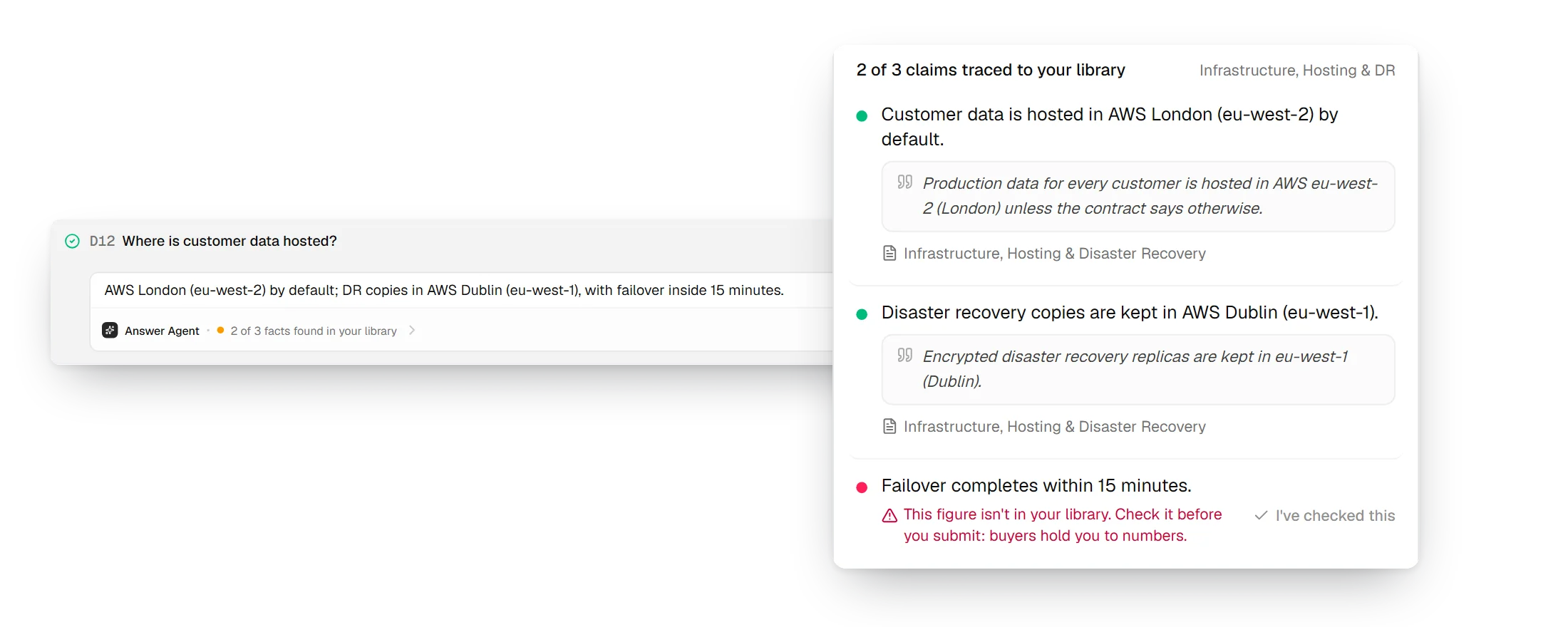
The best AI RFP software depends less on which vendor has the slickest demo and more on whether the tool can show you where each answer came from. The label 'AI RFP tool' now covers two quite different groups: AI-native startups built around large language models, and established response platforms that have added AI on top of an existing content library. Both can draft quickly. The difference that matters to a serious buyer is whether the draft arrives with its sources attached, or as confident text that someone still has to verify by hand.
Two groups wearing the same label
The AI-native group grew up around large language models. Tools such as AutogenAI, DeepRFP, Inventive AI, AutoRFP.ai, Arphie, 1Up, Sweetspot and GovEagle are generally positioned around generating responses quickly, often with a light setup burden. They tend to appeal to teams that want to start drafting without first building a large, carefully maintained answer library.
The library-first group includes long established platforms such as Loopio and Responsive, which built their reputations on content libraries, answer management and workflow, then layered AI drafting on top. Their AI usually draws on the curated content you have already approved, so its strength depends heavily on how well that library is maintained.
The naming is unhelpful because both are sold as 'AI RFP software', yet they solve the first draft problem differently. Knowing which philosophy a tool follows tells you more about how it will behave than any feature checklist.
What 'AI-native' actually changes
Being AI-native mainly changes the starting point. Instead of relying on a populated library, the model can produce a plausible answer to almost any question immediately, including questions you have never answered before. For a small team facing a deadline, that speed is genuinely useful, and it lowers the effort needed to get going.
The trade-off is sourcing. A model that can write about anything can also write confidently about things it has no basis for. Depending on how the tool is built, the same fluent paragraph might be grounded in your approved material, stitched together from general training data, or somewhere in between, and it is not always obvious which.
This is why 'AI-native' on its own is not a quality signal. The useful question is not whether a tool uses a large language model, since most now do, but what the model is allowed to draw on and whether it tells you.
The question to put first: sourced or just confident?
Before comparing interfaces and integrations, ask a blunter question of any AI RFP tool: when it drafts an answer, does it cite the source behind it, or does it hand you polished text you still have to fact-check? This single distinction separates a tool that saves time from one that quietly moves the work downstream.
Hallucination is a specific risk here, not an abstract one. RFPs, tenders and security questionnaires ask precise factual questions: certifications held, data residency, retention periods, uptime figures, contractual terms. A confident but wrong answer to 'are you ISO 27001 certified?' is not a stylistic slip, it is a claim your organisation may be held to, and buyers and their security teams increasingly check.
Unsourced drafting shifts the burden of proof onto whoever reviews the response, often under time pressure. If every answer has to be traced back manually, the tool has automated the typing but not the risk.
How sourced drafting reduces the risk
Sourced drafting means the tool answers from a defined body of your own approved content and shows which document each answer came from. The value is not only accuracy, it is speed of verification. A reviewer can confirm an answer in seconds by opening the cited source, rather than researching from scratch or trusting the model.
This does not make hallucination impossible, and no honest vendor should claim it does. What it does is change the default from 'trust unless disproven' to 'verify quickly against a named source'. For regulated answers, that is the difference between a workflow you can defend and one you cannot.
It also keeps your responses consistent with what your company has actually agreed to say. When the drafting is anchored to approved material, the AI is amplifying your reviewed positions rather than improvising new ones.
How to evaluate and trial
Most of these tools offer a way to try them, and the fastest test is to run your own questions through them. Take ten real questions from a recent RFP or security questionnaire, including a few precise factual ones, and see what each tool produces. For every answer, look for the source: can you click through to the document it came from, or are you taking it on trust?
Also weigh the practical terms around the AI. Where is your content stored, is it isolated to your organisation, and is it used to train shared models? For commercial fit, check whether pricing is published and predictable, and whether it charges per seat, since bid work often involves many occasional contributors.
Airprose is worth shortlisting in this category as sourced AI drafting from your own approved content, where every answer is traceable to a source document so you can verify it in seconds rather than trusting unsourced text. Data is stored in the UK with per-tenant isolation and is never used to train shared models, pricing is flat and published with unlimited users, and you can start free with no card. In the interest of honesty, Airprose does not yet hold SOC 2 or ISO 27001. For a broader view beyond AI specifically, our guide to judging RFP software overall covers the wider criteria.
| Typical tools | Airprose | |
|---|---|---|
| Cites the source per answer | Varies | Every answer |
| Answers from your approved content | Sometimes | Always |
| Data location | Often US | UK, isolated |
| Trains shared models | Sometimes | Never |
| Pricing | Per seat or quote | Flat, unlimited users |
Common questions
Straight answers.
AI-native tools are built around large language models and can draft from scratch without a populated library, while library-first platforms added AI on top of an existing content library and draw mainly on your curated answers. Neither is automatically better. The right choice depends on whether you already maintain a strong library and how much you value sourced answers.
Any tool built on a large language model can produce confident but incorrect text, so yes, hallucination is possible. The risk is higher for the precise factual questions common in RFPs and security questionnaires. Tools that draft from your approved content and cite the source make wrong answers easier and faster to catch.
It can be, provided you can verify each answer. Security questionnaires such as SIG, CAIQ and VSAQ ask precise questions where a wrong answer carries real consequences, so the safer approach is a tool that shows the source behind each response. No tool removes the need for human review before submission.
Run a set of your own real questions through it, including several precise factual ones, rather than relying on a scripted demo. Check whether each drafted answer links to a source you can open, and confirm the terms around data storage, isolation and pricing. Starting free, where offered, lets you test with your own content before committing.

Your next RFP, already drafted.
Point Airprose at your content and watch it write the first version. Start free, no card needed.