


How to automate RFP responses without losing your voice
A practical method for automating RFP responses: what to automate, what to keep human, and how sourcing keeps drafts trustworthy.

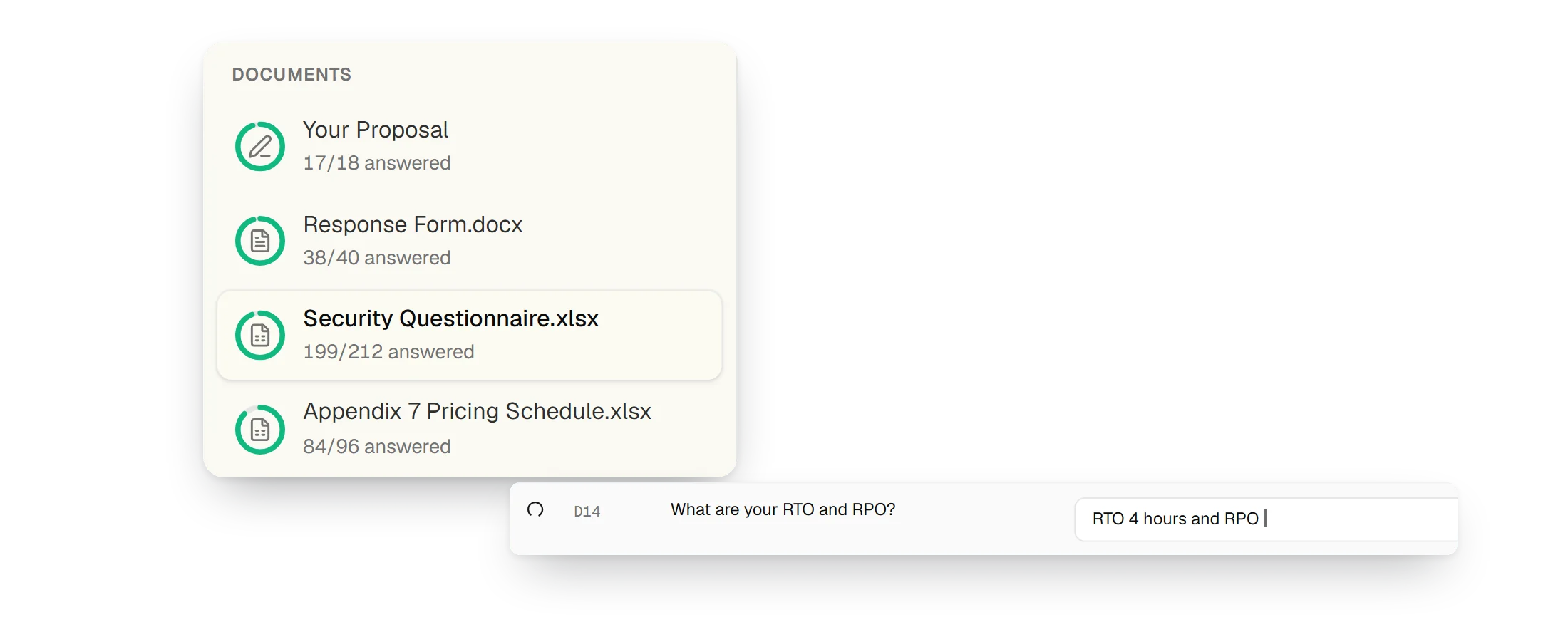
You automate RFP responses by splitting the work into distinct jobs, then automating only the repeatable ones while keeping human judgement on the rest. The parts that suit automation are mechanical, such as finding the right past answer, drafting a first pass, routing for review, and tracking deadlines and versions. The parts that must stay human are the judgement calls: tailoring to a specific buyer, choosing your win themes, and signing off. This guide sets out a method for introducing automation without letting quality or your voice slip.
Start by breaking the process into parts
The common mistake is treating an RFP response as one large task to hand over to a tool, then judging the tool by whether the finished document is good. It rarely is, because a single response blends mechanical work with genuine judgement, and no tool does both well. A better approach is to name the separate jobs inside the process first.
A typical response involves reading the requirements, locating relevant approved content, writing a first draft of each answer, tailoring answers to the buyer, reviewing for accuracy, tracking versions and deadlines, and getting sign-off. Some of these are repeatable and rules based. Others depend on knowing your buyer, your risk appetite, and your commercial position. Once the jobs are separated, you can automate the repeatable ones and leave the rest alone.
This framing matters because it changes what you expect from automation. You are not asking software to win the bid. You are asking it to remove the slow, repetitive parts so your team spends its limited time on the parts that actually decide the outcome.
What is safe to automate
Finding the right past answer is the clearest candidate. Most questions in an RFP resemble questions you have answered before, and searching old bids by hand is slow and error prone. Automated retrieval of approved content is faster and more consistent, provided the source library is well maintained.
Drafting a first pass is the next. A tool can assemble a reasonable starting answer from your approved material, which is quicker to edit than a blank page. Routing for review also automates well: sending each answer to the right subject matter expert, chasing responses, and flagging what is still outstanding. Deadline and version tracking belong here too, because they are pure administration and are exactly where manual processes tend to fail under time pressure.
The test for whether something is safe to automate is simple. If the job is repeatable, has a clear right answer, and does not require knowing this particular buyer, it is a good candidate. If it fails any of those, keep a person in charge of it.
What must stay human
Final judgement stays human. Deciding what to emphasise, what to leave out, and how to position a weakness is a commercial decision that depends on context a tool does not have. So does tailoring to the specific buyer: reflecting their sector, their stated priorities, and the relationship you have with them is what separates a generic response from a competitive one.
Your voice and win themes are also human work. A drafted answer can be accurate and still sound like nobody in particular. The threads that make a bid persuasive, the reasons a buyer should choose you rather than simply the reasons you meet the requirement, come from people who understand the account. Sign-off is the final human gate, because someone has to own what the organisation is committing to.
Treating these as non negotiable protects quality. Automation should hand your team a faster starting point, not a finished document that quietly ships without anyone truly reading it.
Why sourcing is what makes automation trustworthy
The reason many teams distrust automated drafting is that an unsourced answer has to be verified from scratch. If a tool produces confident text with no indication of where it came from, a reviewer cannot tell an accurate claim from an invented one, so they end up rewriting or re-checking everything. That removes most of the time the automation was supposed to save.
Sourcing changes the economics. If each drafted answer is traceable to a specific approved document, a reviewer can verify it in seconds by checking the source rather than rebuilding the answer. Automation becomes trustworthy not because the draft is always perfect, but because a human can confirm or correct it quickly and with evidence.
This is why the quality of your approved content library matters as much as the tool. Good sourcing depends on having current, approved answers to point at. Automation makes that library more valuable, and a weak library makes automation less useful.
A sequence for introducing automation
Introduce automation in order rather than all at once. First, build an approved answer library from your best past responses, security questionnaires, and policy documents, and keep it current. Second, automate the first draft so answers are assembled from that library rather than written from scratch. Third, keep a human review gate that no answer skips, with sourcing visible so review is fast. Fourth, measure: track time saved, how often drafts are accepted with light edits, and whether win rates hold. If quality or voice slips, tighten the review gate before widening automation.
The tool landscape reflects different bets on where automation adds value. Upland comes from the established response management world, Inventive AI, AutoRFP.ai and DeepRFP are AI native drafting tools, and AutogenAI focuses on bid writing at scale. They are worth comparing on how they source content, how review works, and how they handle your data, rather than on drafting speed alone.
Airprose fits this method as sourced first-draft automation. It drafts responses to RFPs, RFIs, tenders, security questionnaires such as SIG, CAIQ and VSAQ, and DDQs from your own approved content, and every answer is traceable to a source document so a reviewer can verify quickly. Data is stored in the UK with per-tenant isolation and is never used to train shared models. In the interest of honesty, Airprose does not hold SOC 2 or ISO 27001 certification yet. It offers unlimited users rather than per-seat pricing, flat published pricing, and is free to start with no card, so you can test it against this method before committing.
Common questions
Straight answers.
It can, if you automate the wrong parts. Automating retrieval and first drafts is fine, but tailoring to the buyer and your win themes must stay human. Keep those as a required step and the finished response should still sound like you.
A general AI writing tool generates fluent text that a reviewer has to verify from scratch, because there is no indication of where a claim came from. A sourced tool ties each drafted answer to an approved document, so a reviewer can confirm it quickly against the source instead of rewriting it.
Start with an approved answer library built from your best past responses, then automate the first draft from it. That gives the fastest gain with the least risk, because you are reusing content you already trust. Add review automation and tracking once the library is working.
It depends on the tool, so ask where data is stored, whether tenants are isolated, and whether your content trains shared models. Airprose stores data in the UK with per-tenant isolation and does not use it to train shared models. It does not hold SOC 2 or ISO 27001 certification yet, so weigh that against your own requirements.

Your next RFP, already drafted.
Point Airprose at your content and watch it write the first version. Start free, no card needed.