


The best software for answering security and vendor questionnaires
How to choose software for answering SIG, CAIQ and VSAQ security and vendor questionnaires, including the two tool families and how to trial one.

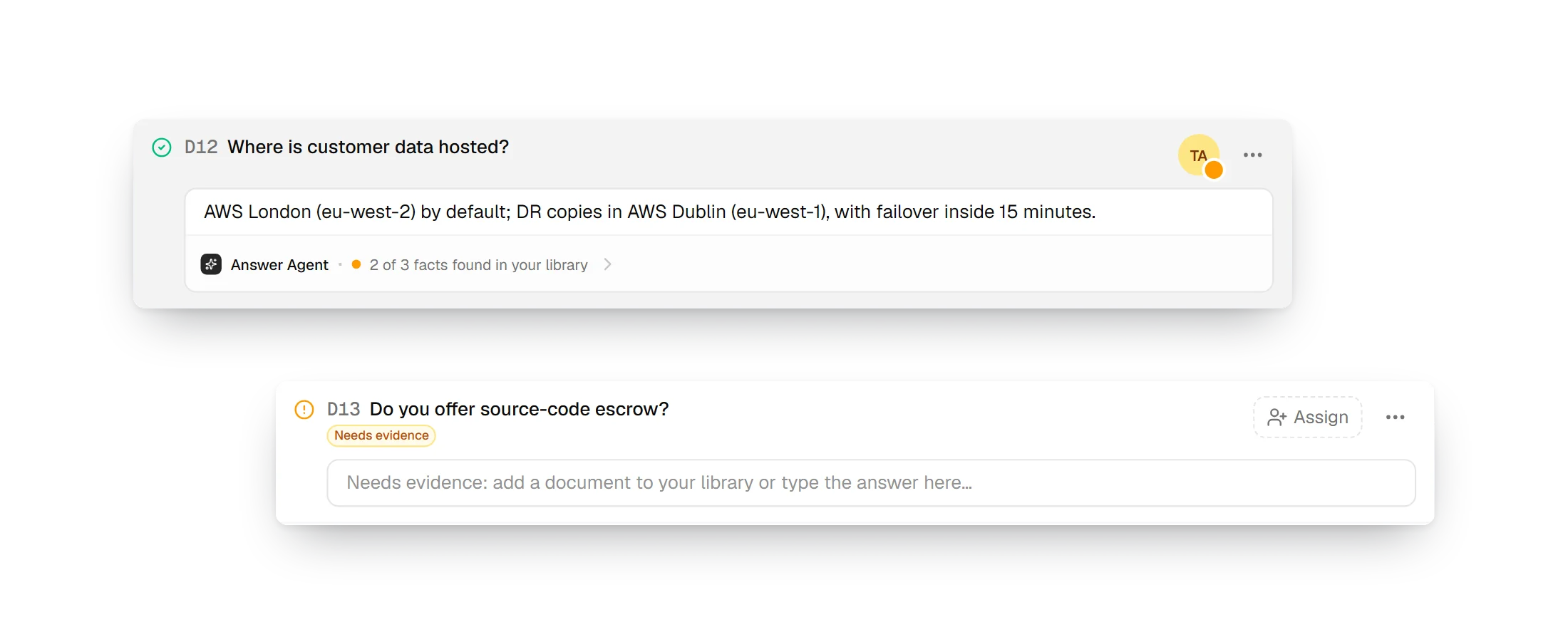
The best software for answering security and vendor questionnaires depends on which job you actually need done, because the market splits into two families that share a label but solve different problems. One family manages your evidence, controls and a public trust centre. The other drafts the actual free-text responses to SIG, CAIQ, VSAQ and bespoke questionnaires from your security evidence. Many teams end up needing both, so the useful question is not which tool wins overall but which tool does the part you are struggling with.
Why security questionnaire software means two different things
Search for security questionnaire software and you will find lists that mix two categories together as if they were interchangeable. They are not. Buying the wrong family is the most common reason a team invests in tooling and still finds the questionnaire backlog untouched.
The first family is compliance and trust-centre automation. It watches your controls, gathers evidence, maps everything to frameworks and often publishes a public page where prospects can self-serve your certifications and documents. The second family is answer drafting. It takes an incoming questionnaire and writes the responses for you, pulling from a library of your approved content. Understanding which side of that line a product sits on tells you most of what you need to know before a single demo.
Family one: compliance and trust-centre automation
Tools such as Vanta and Drata sit close to your systems. They monitor controls continuously, collect evidence automatically and help you reach and maintain frameworks like SOC 2 and ISO 27001. Products such as SafeBase and Conveyor focus on the outward-facing side, hosting a trust centre where buyers can view your security posture, request documents and, in some cases, get standard questions answered without emailing your team.
This family is valuable when your problem is proving and organising your security programme, or when the same evidence is requested so often that a self-serve trust centre removes real work. It is worth remembering that publishing a trust centre and monitoring controls is a different task from writing a tailored answer to question 147 of a bespoke spreadsheet.
The limit to watch for is the long tail. A trust centre handles the questions you can anticipate. Many enterprise buyers still send their own format with hundreds of free-text items that do not map cleanly to any pre-built page, and those are the ones that consume your week.
Family two: answer-drafting tools
The second family exists to write responses. Loopio and Responsive grew from the RFP world and centre on a content library your team curates, then reuse and adapt that content across questionnaires. Vendict and AutoRFP.ai lean more specifically towards security questionnaires and use models to draft answers from your existing material. Panorays is worth separating out here, as it is aimed at assessing third parties you rely on rather than answering the questionnaires sent to you, which is the opposite direction of work.
The promise across this family is speed. Instead of copying from an old spreadsheet or writing from scratch, you import the questionnaire and receive draft answers to review. The differences between products come down to how they source those drafts, how much editing the output needs and whether the library stays accurate over time.
The risk to weigh is confident but wrong text. A tool that generates fluent answers from stale or unsourced content can make an error harder to catch, not easier, because the writing reads as if someone checked it. That is why the next point matters more than any feature list.
The test that actually matters: traceable, current answers
Whatever family you lean towards, the real test is whether each drafted answer traces back to your genuine security evidence, and whether you can confirm that in seconds rather than trusting the tool. A reviewer should be able to click an answer and see the exact source document, policy or control it came from. Without that link you are reading prose and hoping it is true, which is the situation good tooling is meant to remove.
The second half of the test is currency. Controls change, sub-processors change and certifications lapse and renew. If a drafted answer quotes a source from a year ago, you need the tool to make that obvious so an old figure does not go out under your name. Ask any shortlisted vendor to show you exactly what happens to an answer when its underlying evidence is updated, and how a reviewer is warned that a source is out of date.
These two properties, traceability and currency, are what separate tooling that reduces your risk from tooling that simply produces text faster. They are also easy to test, which is what the trial below is for.
| Typical tools | Airprose | |
|---|---|---|
| Answer traceable to evidence | Varies | Every answer |
| Flags stale evidence | Not always | Sourced, checkable |
| Data location | Often US | UK, isolated |
| Trains shared models | Sometimes | Never |
| Pricing | Per seat or quote | Flat, unlimited users |
How to shortlist and run a real trial
Start by naming your actual bottleneck. If you are chasing certifications and repeat evidence requests, shortlist from the compliance and trust-centre family. If a stack of unanswered free-text questionnaires is what stalls deals, shortlist from the answer-drafting family. If both are true, plan to combine one of each rather than expecting a single product to excel at both.
Then trial with your own questionnaire, not the vendor's demo file. Take a recent SIG, CAIQ or VSAQ style document you have already completed, run it through each shortlisted tool and compare the drafts against your known-good answers. Check three things: how much editing each draft needed, whether every answer showed its source, and whether the tool flagged anything based on outdated evidence. Involve the security reviewer who signs off answers, since their time is the real cost you are trying to reduce.
Airprose sits in the answer-drafting family. It drafts security and vendor questionnaire responses from your own approved content, with each answer linked to the source document so a reviewer can verify it in seconds instead of trusting unsourced text. Data is stored in the UK with per-tenant isolation and is never used to train shared models, pricing is flat and published with unlimited users, and you can start free with no card. In the interest of an honest shortlist, Airprose does not yet hold SOC 2 or ISO 27001, so if a certified vendor is a hard requirement for your own suppliers, weigh that openly. It is one option worth trialling with your real questionnaire alongside the others.
Common questions
Straight answers.
Often yes, because they solve different problems. A trust centre handles predictable, repeat requests and proves your posture, while an answer-drafting tool writes the tailored free-text responses to bespoke questionnaires. Teams with heavy inbound questionnaire volume usually find one of each covers more ground than either alone.
Some can answer standard questions through a trust centre, but the long tail of bespoke, free-text questionnaires is not their core job. If most of your effort goes into writing tailored responses, look at the answer-drafting family for that specific task and keep the compliance tool for evidence and controls.
Insist on traceability. A drafted answer should link to the exact source document or control it came from, so a reviewer can confirm it in seconds rather than trusting the wording. Also check that the tool flags when a source has changed, since an answer built on stale evidence can read as convincingly as a current one.
Not yet, and it is fair to say so plainly. Airprose stores data in the UK with per-tenant isolation and does not use your content to train shared models, but it does not currently hold SOC 2 or ISO 27001. If a certification is mandatory for your suppliers, factor that into your shortlist alongside how each tool sources its answers.

Your next RFP, already drafted.
Point Airprose at your content and watch it write the first version. Start free, no card needed.