


Security questionnaire automation: a practical guide
A security questionnaire is a list of questions a prospect or partner sends to check how you protect their data before they buy or renew. Security questionnaire automation is software that drafts the answers from a library of responses you have already approved, so a questionnaire that used to take days takes a few hours.

What a security questionnaire is for
When a company evaluates a vendor, its security or procurement team wants evidence that the vendor handles data safely. The questionnaire is how they collect that evidence in writing. Answers become part of the contract record, so accuracy matters as much as speed. A wrong answer about encryption or data residency can surface later in an audit or a breach investigation.
The formats you will see
Most questionnaires fall into one of three buckets. The Standardized Information Gathering questionnaire (SIG), maintained by Shared Assessments, is a large spreadsheet used widely in financial services. The Consensus Assessments Initiative Questionnaire (CAIQ), maintained by the Cloud Security Alliance, maps to its Cloud Controls Matrix. The third bucket is custom: a spreadsheet or portal a customer built themselves, often a mix of questions borrowed from the standard frameworks plus items specific to their industry.
Standardized Information Gathering
A large spreadsheet from Shared Assessments, used widely in financial services.
Consensus Assessments Initiative Questionnaire
From the Cloud Security Alliance. Maps to its Cloud Controls Matrix.
Custom questionnaires
Built by the customer. Standard questions plus items specific to their industry.
You rarely get to choose. A single deal can involve a SIG Lite for the first stage, a full custom questionnaire for security review, and a separate privacy addendum.
Why they take so long by hand
The work is repetitive, but it is not mechanical. Each question needs an answer that is true for your current setup, phrased for this customer, and consistent with what you told the last customer. A person answering by hand has to find the last good answer, check it is still accurate, adjust the wording, and note where the evidence lives. Across a few hundred questions, that adds up to days, and it usually lands on a small number of people who also have other jobs.
Consistency is the quiet problem. When three people answer questionnaires from three copies of an old spreadsheet, the same control gets described three different ways. Reviewers notice, and the differences invite follow-up questions.
What automation actually does
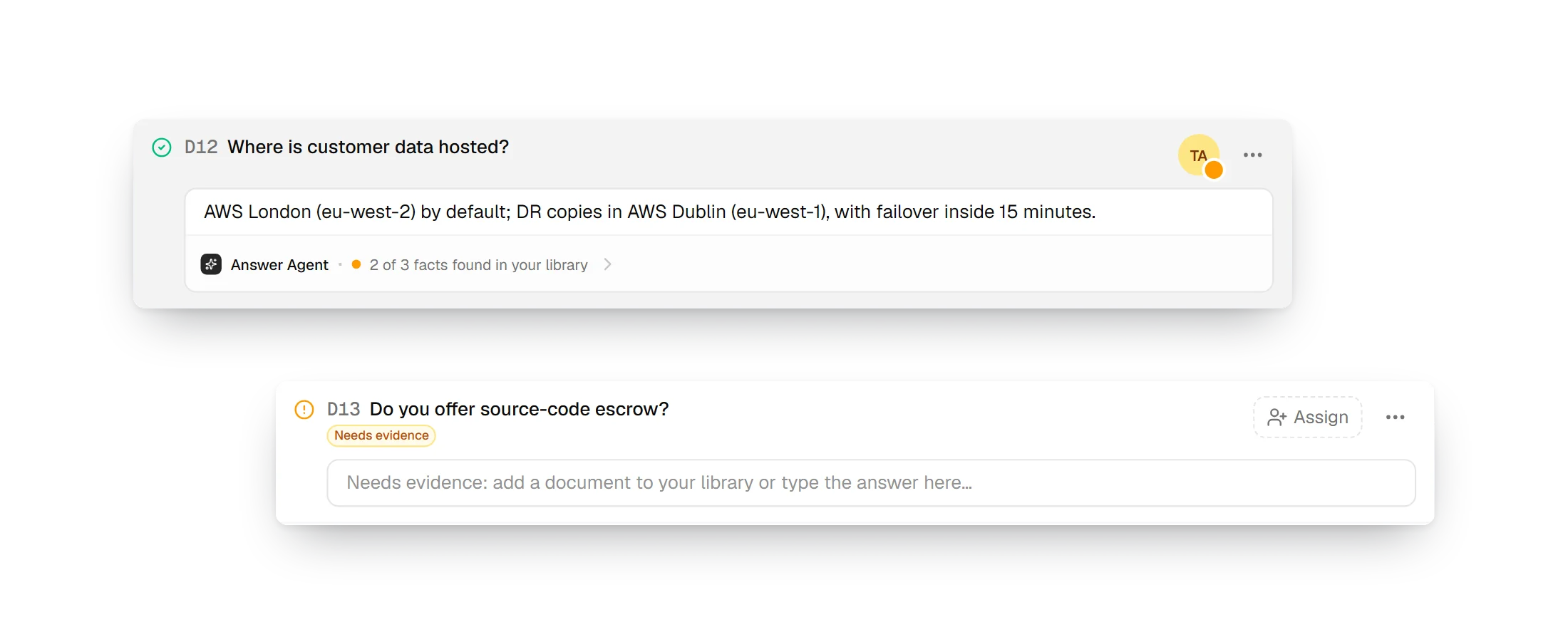
Good automation keeps one library of approved answers and drafts each questionnaire from it. You upload the customer's file, the software matches each question to the closest approved answer, and it fills in a draft. A person reviews the draft, edits anything that needs nuance, and exports the finished file in the format the customer expects.
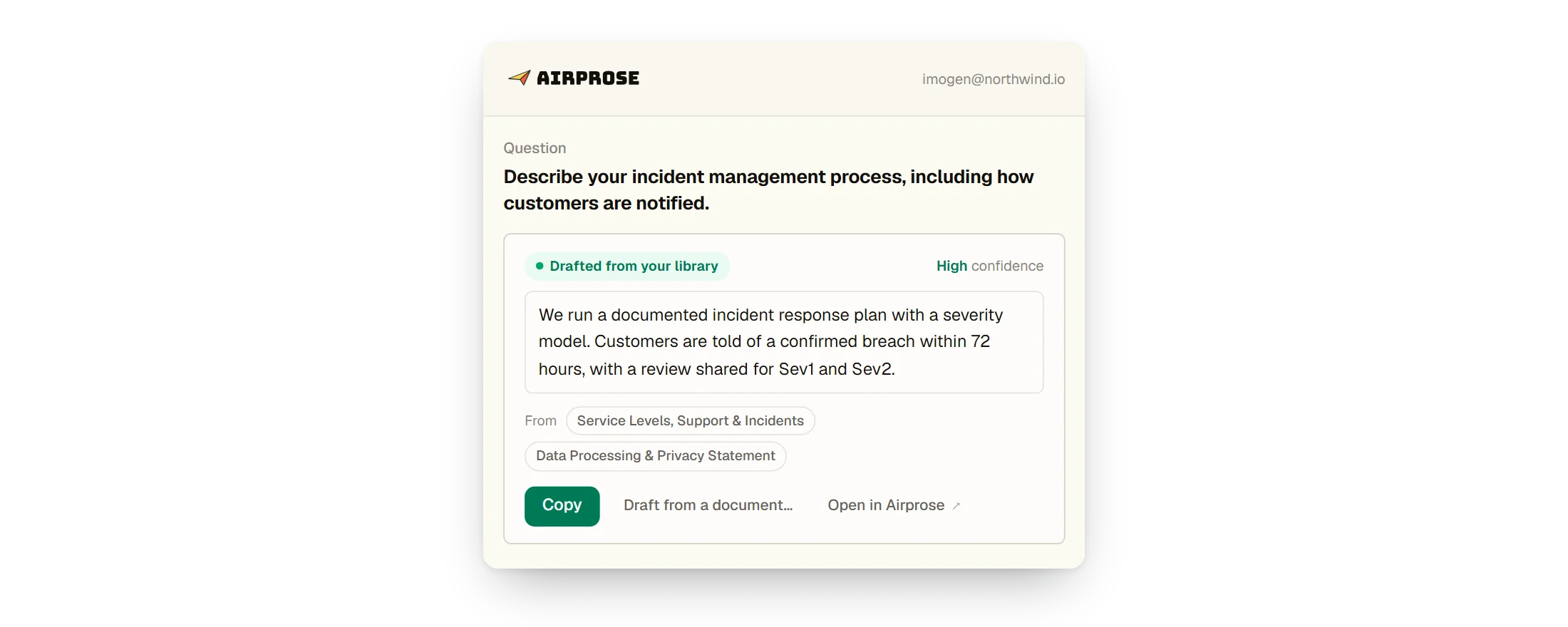
The important part is where the answers come from. Answers should be drawn from content you control and marked with their source, so a reviewer can see why the software wrote what it wrote. A tool that generates plausible security claims without a source is a liability, because someone still has to sign the document.
What to look for in a tool
A few questions separate useful tools from risky ones. Does every answer show its source, so a reviewer can trust it without re-checking from scratch? Does the library stay current, or does it drift as your controls change? Can it handle the customer's own format, not only the standard frameworks? And does it keep your content private, rather than feeding it into a shared model that other companies benefit from?
How Airprose handles security questionnaires
Airprose drafts each answer from your approved content and shows the source next to it. If it cannot support an answer from your library, it flags the question rather than guessing. Your content stays in the UK with per-tenant isolation and is not used to train shared models. SOC 2 and ISO 27001 certification are on our roadmap, not in place yet, and we say so plainly rather than implying otherwise.
Common questions
Straight answers.
A security questionnaire is a list of questions a prospect or partner sends to check how you protect their data before they buy or renew. The answers become part of the contract record, so accuracy matters as much as speed.
The most common are the SIG (Standardized Information Gathering) questionnaire from Shared Assessments, the CAIQ (Consensus Assessments Initiative Questionnaire) from the Cloud Security Alliance, and custom questionnaires that customers build themselves.
It keeps one library of approved answers and drafts each questionnaire from it. You upload the customer's file, the software matches each question to an approved answer, a person reviews and edits, and you export the finished file in the format the customer expects.
Check that every answer shows its source, that the answer library stays current as your controls change, that it handles custom formats and not only the standard frameworks, and that your content stays private rather than training a shared model.
Resources
Read before you bid. Guides on the work itself.
The best software for answering security and vendor questionnaires
How to choose software for answering SIG, CAIQ and VSAQ security and vendor questionnaires, including the two tool families and how to trial one.

What is a vendor risk assessment, and how does it work?
Vendor risk assessment explained: the process, templates, and reports, plus how to answer them faster with sourced, on-brand responses.


See it on your own questionnaire.
Upload it, and watch the first draft build itself. Start free, no card needed.